
Your AI velocity is manufacturing liabilities
If you lead engineers, you'll recognize this one. It usually starts as the best week of the quarter — and ends as somebody else's 3 a.m.
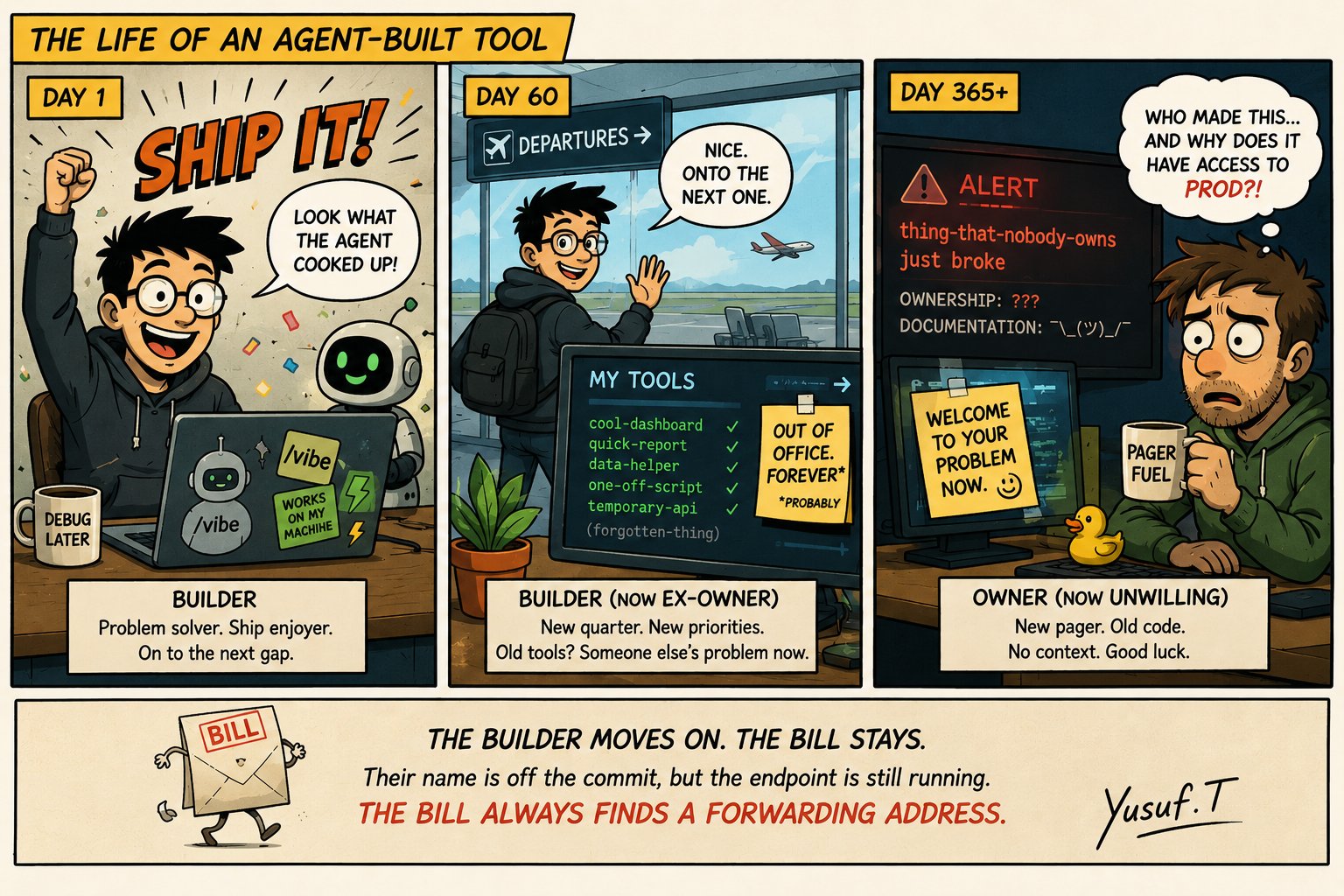
This isn't an argument against speed. Agents make creation cheap — they just don't make ownership cheap. The failure mode isn't velocity; it's the durable artifact nobody signed up to own. Here's how it goes:
 🔍 Tap to zoom
 🔍 Panel text is small on phones — tap the comic to enlarge.
Strip away the cartoon and the mechanism is serious: the agent made the artifact cheap to create, but nothing made it cheap to own. The friction everyone wanted gone was doing quiet work — it was the gate that forced someone to decide whether a thing was worth owning before it existed.
The friction was not just the obstacle, it was also the filter.
And this isn't only about internal tools. The artifact might be a dashboard, a script, a generated API, a workflow automation, a data pipeline, a runbook, a remediation bot — or any other feature you ship. The arc is identical. Each one adds to your obligation surface: the set of things someone is now on the hook to run, secure, and keep correct. Agents grow that surface far faster than anyone is growing the list of owners.
The problem isn't that agents create things. It's that temporary things quietly become durable.
The fix isn't slower agents. It's treating agent-built artifacts like production assets the moment they become durable. Build whatever you want — prototype aggressively. But once an artifact is durable, it needs three things:
INSERT. We just never wrote the TTL — so the stack became an append-only log nobody compacts.Each of these does the job the old friction did for free: it forces the question speed made cheap to skip — not "can we build it," but "who depends on it, and who owns it, a year from now."
Agents make creation cheap. They don't make ownership cheap. Any artifact that becomes durable without an owner, a usage signal, and a renewal path isn't velocity — it's deferred liability.